Terraced vs Semi-Detached House: Which Is Better to Buy?
Published By FJP Investment Editorial Team
Last updated: August 2026
For many UK homebuyers, the choice eventually comes down to two of the country’s most familiar types of property: terraced vs semi-detached.
Both can make excellent homes and both can work well as investment properties, but they offer different advantages.
A terraced house will often provide a relatively affordable route into a particular area and may have lower heating requirements because it shares walls with neighbouring properties. A semi-detached house will usually provide more separation from neighbours and may offer additional outside space, parking or potential to extend.
That does not mean that one type is automatically better than the other.
A well-located Victorian terrace can be considerably more desirable than a poorly positioned semi-detached house, while a spacious semi with a driveway and large garden may command a substantial premium over neighbouring terraces.
The right choice depends on the individual property, its location, condition, price and what you want from it.
This guide compares terraced and semi-detached houses across price, space, noise, energy efficiency, maintenance, parking, extensions, resale value and investment potential.
Terraced vs semi-detached: the quick comparison
| Consideration | Terraced house | Semi-detached house |
|---|---|---|
| Shared walls | Usually two for a mid-terrace | Usually one |
| Purchase price | Often lower within the same local market | Often higher |
| Privacy | Generally less | Generally more |
| Noise from neighbours | Potentially from both sides | Potentially from one side |
| Energy efficiency | Mid-terraces can benefit from fewer exposed external walls | More exposed walls may increase heat loss |
| Garden | Often narrower or smaller | Frequently larger, but not always |
| Parking | More variable, particularly in older urban terraces | More likely to have side access or a driveway in suburban areas |
| Extension potential | Possible, but often more constrained | Side and rear space can create more options |
| Maintenance | Less external wall area, but access can be awkward | More exterior to maintain but often easier access |
| Typical buyer appeal | First-time buyers, couples, small families and urban buyers | Families and buyers wanting more space and privacy |
These are general characteristics rather than rules. There are large terraced houses, tiny semi-detached houses, terraces with substantial gardens and semis without off-street parking.
The individual property always matters more than the label.
What is a terraced house?
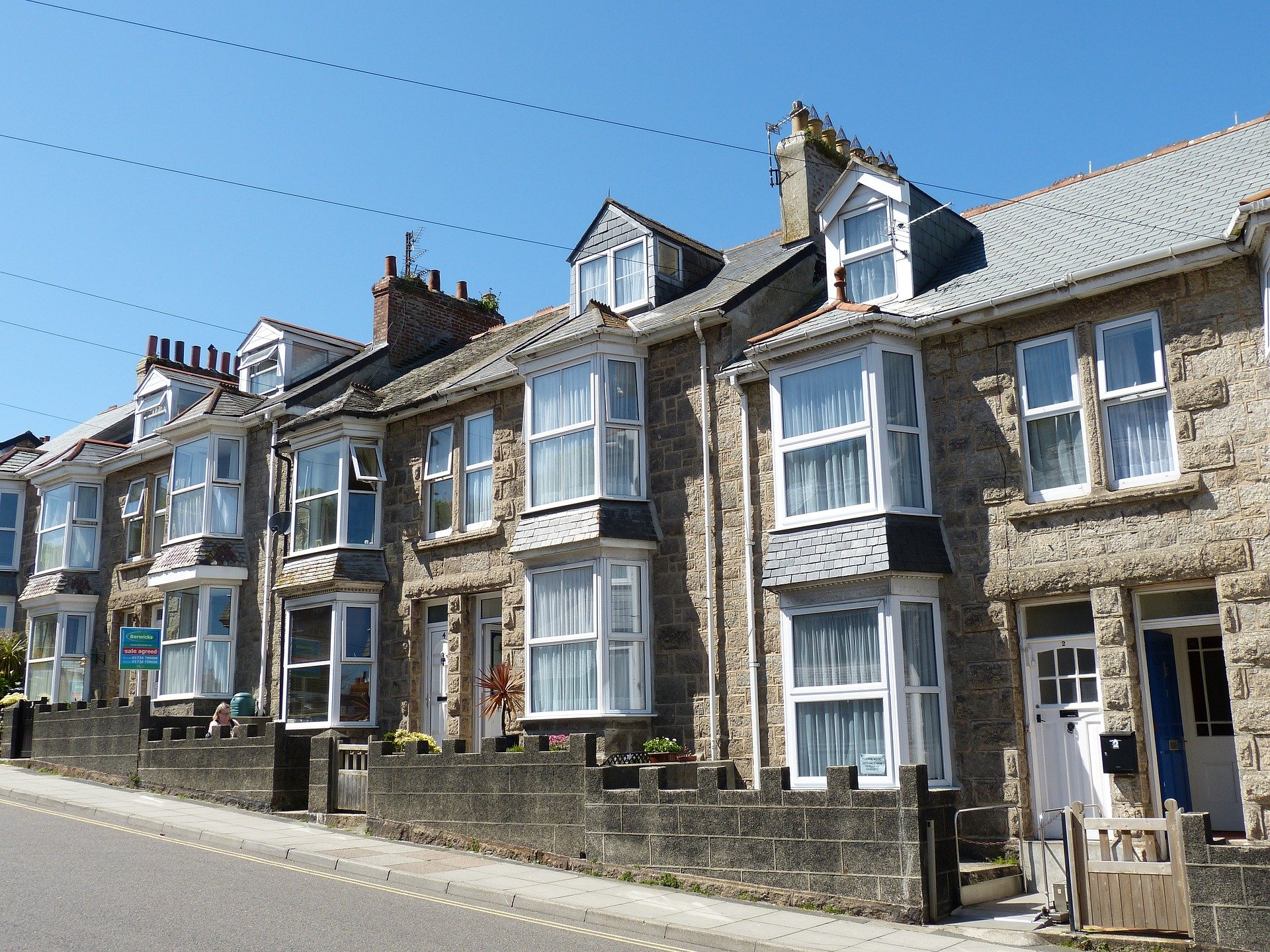
A terraced house forms part of a continuous row of properties joined by shared side walls.
A mid-terrace normally has another house attached on both sides. An end-of-terrace property sits at the end of the row and therefore generally shares only one side wall.
Terraced housing is a familiar feature of towns and cities throughout the UK, particularly in areas developed extensively during the Georgian, Victorian and Edwardian periods.
They range enormously in size.
A compact two-bedroom worker’s cottage and a large five-storey London townhouse can technically both be terraced properties.
One of their major attractions is efficient use of land. Building properties alongside each other allows a relatively high number of homes to be provided without requiring the larger plots associated with detached housing.
This is one reason terraces remain particularly common in urban areas.
What is a semi-detached house?
A semi-detached house is one of a pair of houses that share a single adjoining wall.
The other side of the property is detached.
Semis became particularly widespread during the expansion of British suburbs and remain one of the country’s most recognisable house types.
Many offer side access, front and rear gardens, private driveways and more land than equivalent terraced properties, although this varies considerably by location and period of construction.
For buyers, the attraction is often straightforward: a semi provides some of the benefits associated with a detached house without usually carrying the same purchase price.
Our wider guide to the different types of houses found in the UK explains how terraces and semis compare with detached houses, flats, bungalows and other property types.

Are terraced houses cheaper than semi-detached houses?
Within the same local market, a comparable terraced house will often cost less than a semi-detached property.
There are logical reasons for this.
The semi may have a wider plot, only one adjoining neighbour, greater external space, side access and more potential for parking or extending.
Those features can command a premium.
However, buyers should be careful about making comparisons purely by property type.
Location remains one of the strongest influences on house prices.
A terraced house on a highly desirable road, within a strong school catchment or close to a station may cost much more than a larger semi-detached property only a few miles away.
The correct comparison is therefore not:
“Are semis worth more than terraces?”
It is:
“What do comparable terraced and semi-detached properties sell for in this particular area?”
Recent completed sales are generally much more useful than relying on national averages.
Which gives you more space?
Semi-detached homes often have an advantage when it comes to space, but again it is not universal.
The plot tends to be wider because the property has an exposed side. This may provide:
- side access to the rear garden;
- space for bins and bicycles;
- additional windows;
- a driveway;
- garage space; or
- room for a side extension, subject to the necessary approvals.
Terraced houses use their plots differently.
Many older terraces are relatively narrow but deep, with rooms arranged one behind another. Others have been extended substantially at the rear or converted into the loft.
For buyers, usable space matters more than simply looking at the total square footage.
A smaller house with a sensible layout may work much better than a larger property containing awkward corridors, small rooms or poorly executed extensions.
Are semi-detached houses quieter than terraced houses?
Potentially, yes.
A mid-terraced house has neighbours attached to both sides, whereas a semi-detached house normally shares only one wall.
That means there is one fewer adjoining household from which noise can potentially travel.
But construction quality makes an enormous difference.
Some older houses have substantial masonry party walls that provide good acoustic separation. Other properties may transmit televisions, doors, voices or impact noise surprisingly easily.
Renovations can also affect noise transmission.
Hard flooring, altered fireplaces, removed chimney breasts and changes to internal layouts can all change the way sound behaves.
If noise is particularly important to you, do not assume a property will be quiet simply because it is semi-detached.
Visit at different times of day if possible and pay attention to the shared wall.
What about party walls?
Both terraced and semi-detached houses commonly contain a party wall separating adjoining homes.
This becomes particularly relevant if you plan to carry out certain building work.
The Party Wall etc. Act 1996 applies in England and Wales and can cover work including certain alterations to an existing party wall, construction on or near a boundary and excavation close to neighbouring buildings.
Examples can include some loft conversions, removing chimney breasts, cutting into a party wall for structural work or excavating foundations for an extension.
The fact that you own your property does not mean you can ignore the procedures simply because the building work is taking place primarily on your side.
Anyone planning substantial work to a terraced or semi-detached property should establish whether the Party Wall etc. Act applies before work begins.
Party wall requirements are also separate from planning permission and building regulations.
Which is more energy efficient: terraced or semi-detached?
From a purely structural perspective, a mid-terraced house can have an advantage because fewer of its walls are exposed directly to the outside.
Heat can escape through external walls, so having neighbouring houses on both sides can reduce the amount of exposed building envelope.
A semi-detached house has an additional exposed side wall, while an end-of-terrace also loses some of the mid-terrace advantage for the same reason.
But property type is only one factor.
Actual energy performance depends on:
- insulation;
- windows and glazing;
- heating system;
- roof construction;
- draught-proofing;
- floor insulation;
- property age;
- extensions and alterations; and
- how the occupants use the home.
A modernised semi-detached home can therefore be considerably more energy efficient than an uninsulated Victorian terrace.
When buying, the property’s Energy Performance Certificate (EPC) provides a useful starting point. An EPC rates the energy efficiency of a home from A to G and includes recommendations for possible improvements.
Our article on energy efficiency and property looks at this subject in more detail.
Which costs more to maintain?
There is no automatic winner.
A semi-detached house normally has more external wall area and potentially more garden, fencing, driveway and roof edge to maintain.
A mid-terrace may have less exposed exterior, but carrying out work can sometimes be more awkward.
For example, if there is no rear access, building materials, garden equipment or waste may need to pass through the property.
Roof and gutter work may also involve closer coordination with adjoining owners.
Age and condition will usually have a far greater impact on maintenance costs than whether a house is terraced or semi-detached.
A recently refurbished terrace could require far less work over the next five years than a neglected semi with an ageing roof, windows and heating system.
Which is better for parking?
Semi-detached properties often have an advantage because their wider plots may include side space or a driveway.
Many older urban terraces were constructed long before modern levels of car ownership and may rely heavily on on-street parking.
That distinction can matter more than buyers initially realise.
In areas where parking is scarce, having a private driveway or dedicated parking space can be a meaningful selling point.
It can also make home EV charging considerably easier.
However, there are plenty of terraces with private parking and semis without it, so buyers should treat parking as an individual property feature rather than a guaranteed characteristic.
We explored this issue separately in The Surprising Value of a Parking Space.
Terraced vs semi-detached: which has the bigger garden?
Semi-detached homes often sit on wider plots and can therefore offer more garden space.
Some also have gardens wrapping partly around the side of the house.
Terraced gardens tend to be narrower, but older terraces can have surprisingly long rear gardens.
An end-of-terrace may also benefit from additional side land, making it something of a middle ground between a mid-terrace and a semi.
If garden space matters, look at the actual plot rather than the property description.
A large garden can improve lifestyle appeal but also requires more maintenance, while some buyers may prefer a smaller, easier-to-manage outside area.
Which is easier to extend?
A semi-detached house will often provide more physical options because of the extra land alongside it.
Depending on the property and planning position, there may be potential for:
- a rear extension;
- a side extension;
- a wraparound extension;
- a loft conversion;
- a garage conversion; or
- combining several alterations.
A terraced house can still offer significant extension opportunities, particularly to the rear and into the loft.
Many Victorian terraces have already been altered using rear kitchen extensions and loft conversions.
However, development potential should never be assumed.
Planning rules, permitted development rights, conservation-area restrictions, building regulations, party wall requirements, neighbouring properties and the physical characteristics of the site can all affect what is possible.
It is also important not to overdevelop a property.
An extension that removes almost the entire garden or creates an awkward internal layout may not add as much value as the owner expects.
Is an end-of-terrace basically the same as a semi-detached?
They share some characteristics, but they are not the same property type.
An end-of-terrace has another property attached on only one side, just like a semi.
That can provide several similar advantages:
- fewer adjoining neighbours;
- additional side windows;
- potential side access;
- more external wall space; and
- sometimes a larger plot.
However, an end-terrace remains physically part of a longer row of properties rather than one half of a pair.
Its layout, plot and market value may therefore differ from nearby semis.
For buyers who like terraced streets but want fewer shared walls, an end-of-terrace can be worth considering.
Which has better resale value?
There is no reliable rule saying that semi-detached houses always appreciate faster than terraced houses.
Semis often sell for more than comparable terraces because buyers may pay a premium for additional land, privacy and parking.
That is different from saying they necessarily deliver a better investment return.
Imagine a terrace bought for £250,000 that later sells for £300,000 and a semi purchased for £350,000 that later sells for £400,000.
Both have gained £50,000, but the percentage return is different.
Likewise, a terraced property in an improving city neighbourhood may outperform a semi-detached house in a weaker location.
Resale performance is influenced by factors including:
- purchase price;
- location;
- local employment;
- transport;
- schools;
- property condition;
- available housing supply;
- parking;
- garden space;
- energy performance; and
- overall buyer demand.
Property type is one factor among many.
Which is better for buy-to-let investors?
Again, neither property type automatically produces the better investment.
A lower-priced terraced house may produce an attractive rental yield if demand is strong and the purchase cost is relatively modest.
Terraces can work particularly well in locations popular with young professionals, couples and smaller families.
Semi-detached properties may appeal strongly to families who value additional bedrooms, gardens, parking and privacy. That can potentially contribute to longer tenancies in the right area.
But investors should not assume that because a semi commands a higher rent, it automatically provides a higher yield.
If the semi costs substantially more to buy, its percentage rental return could actually be lower.
The calculation should therefore be made using the individual numbers:
annual rental income ÷ total investment cost × 100
Investors should also consider maintenance, financing, void periods, management costs and likely long-term demand rather than concentrating solely on headline rent.
Do tenants prefer terraced or semi-detached houses?
Different tenants prioritise different things.
A professional couple may prefer a well-located terrace within walking distance of restaurants, transport and work.
A family with children may place greater importance on a garden, driveway, school catchment and additional internal space, making a suburban semi more attractive.
The question for a landlord is therefore not simply which type of house tenants prefer.
It is:
Who is the target tenant for this particular location, and what do they value?
Features such as parking, energy efficiency, outdoor space and broadband can sometimes have more influence on tenant demand than whether the property is technically terraced or semi-detached.
Are terraced houses harder to insure?
Not generally simply because they are terraced.
Insurers assess numerous factors including property age, construction, location, claims history, flood risk, subsidence risk and the type of cover required.
Shared walls do, however, mean that an issue originating next door can potentially affect your property.
Water leaks, fire, structural work and damage to shared elements can occasionally involve more than one household.
Semi-detached homes also share a party wall, so this is not unique to terraces.
If a property has unusual construction, a history of subsidence or significant structural alterations, buyers should make sure appropriate insurance can be obtained before committing to the purchase.
Pros and cons of a terraced house
Potential advantages
- Often a lower purchase price than comparable semis.
- Mid-terraces may benefit from reduced heat loss through side walls.
- Common in established urban locations close to amenities.
- Can appeal to a broad first-time buyer and rental market.
- Often efficient use of internal space.
- Potential for rear and loft extensions where appropriate.
Potential disadvantages
- Two adjoining neighbours in a mid-terrace.
- Greater potential for noise transmission.
- Parking may be limited in older urban streets.
- Rear access can be awkward or unavailable.
- Plot width and extension options may be more restricted.
- Some work may require close cooperation with neighbours.
Pros and cons of a semi-detached house
Potential advantages
- Only one directly adjoining neighbour.
- Often more internal and external space.
- Greater likelihood of side access or a driveway.
- Potentially more options for extensions.
- Strong appeal to families in suburban locations.
- Can offer much of the privacy of a detached home at a lower price.
Potential disadvantages
- Usually more expensive than a comparable terrace.
- More exposed external wall area.
- Larger plots can mean more maintenance.
- You still share a party wall with a neighbour.
- Buying at a higher price does not automatically produce a better investment return.
What should you check before buying either type?
Whether the property is terraced or semi-detached, a buyer should look beyond the label.
Consider:
- recent comparable sale prices;
- condition of the roof;
- signs of damp or structural movement;
- age of windows and heating;
- EPC rating;
- sound transmission through party walls;
- parking arrangements;
- garden access;
- boundaries;
- previous extensions;
- planning history;
- future extension potential;
- local schools and transport;
- flood and subsidence risks; and
- general demand in the area.
A professional property survey can be particularly useful when buying an older house. Our guide to what is often flagged during a property survey explains some of the issues buyers may encounter.
Frequently asked questions
Is semi-detached better than terraced?
Not automatically. A semi-detached house usually offers more privacy and may provide more external space, while a terraced property can be cheaper, efficient to heat and located closer to urban amenities. The better option depends on the individual property and buyer.
Are semi-detached houses worth more than terraced houses?
Comparable semi-detached homes often command a higher price because they may offer larger plots, fewer shared walls, more parking and greater extension potential. However, location, condition and size can outweigh property type.
Are terraced houses noisier?
They can be because mid-terraces have adjoining properties on both sides. However, noise levels depend heavily on construction, sound insulation, neighbour behaviour and internal layouts.
Are terraced houses warmer than semi-detached houses?
A mid-terraced home can benefit from having fewer exposed external walls, potentially reducing heat loss. Actual energy efficiency depends on insulation, glazing, heating and the overall condition of the individual property.
Is an end-of-terrace better than a mid-terrace?
An end-terrace provides only one adjoining neighbour and may have extra side space, windows or access. However, it also has an additional exposed wall and may cost more than an equivalent mid-terrace.
Which is better for investment: terraced or semi-detached?
Neither automatically provides the better return. Investors should compare purchase price, achievable rent, tenant demand, maintenance requirements and resale potential in the specific local market.
Do semi-detached houses have better extension potential?
Often, because they may have land alongside the property as well as at the rear. However, any extension remains subject to the property’s physical constraints and relevant planning, building regulation and party wall requirements.
Which is better for a first-time buyer?
Terraced houses can offer a more affordable entry point into some markets, but the right decision depends on budget and priorities. Paying slightly more for a semi may make sense if the buyer expects to need extra space and wants to remain in the property for longer.
Terraced or semi-detached: which should you buy?
There is no universally correct answer.
If affordability, location and lower running costs are the priorities, a good terraced house may be difficult to beat.
If privacy, parking, garden space and the potential to expand the property matter more, a semi-detached house may justify the additional purchase price.
For investors, the decision should be even less emotional.
Look at the numbers.
What is the purchase price? What rent is genuinely achievable? Who is likely to rent or eventually buy it? What maintenance is required? What could be improved? And how strong is demand for that particular type of property in that particular location?
Jamie Johnson, CEO of FJP Investment, comments: “I don’t think you can say a semi is always better than a terrace, or vice versa. Property is too local for that. I’d rather own a very good terrace in the right street than a mediocre semi in the wrong location. The individual deal matters much more than the label on the house.”
That is ultimately the most useful way to approach the comparison.
Buy the right property, in the right location, at the right price.
Whether it happens to share one wall or two should be part of that decision, but it should not make the decision for you.
This article is provided for general information only and should not be regarded as financial, legal or investment advice. Buyers should carry out appropriate due diligence and obtain professional advice where required.